
Dr. Nanor Tchaghlasian provides specialist care at her Throat and Neck Clinic in Dubai for adults and children with throat, voice, tonsil, salivary gland and neck conditions.
A detailed ENT examination helps identify the cause of symptoms and determine whether medical treatment, further investigation, or surgery may be required. Flexible laryngoscopy may also be performed when appropriate to examine the throat, larynx and vocal cords.

Conditions We Treat in Throat and Neck Clinic
Sore Throat and Tonsillitis
Sore throat is a common symptom that may be caused by viral or bacterial infections, tonsillitis, irritation, allergies or acid reflux. Symptoms may include throat pain, difficulty swallowing, fever, swollen tonsils or enlarged neck lymph nodes.
Tonsillitis is inflammation of the tonsils and may occur in both children and adults. It is commonly caused by viral infections, although bacterial infections such as Group A Streptococcus (strep throat) can also occur.
Patients with severe, persistent or recurrent symptoms may require an ENT examination. Depending on the clinical findings, investigations such as a rapid strep test, throat culture or blood tests may be recommended.

How is Tonsillitis Diagnosed?
Diagnosis is based on the patient’s symptoms and examination of the throat, tonsils and neck. The tonsils are assessed for redness, swelling and exudate, and the neck is examined for enlarged lymph nodes.
When a bacterial infection such as Group A Streptococcus is suspected, a rapid strep test or throat culture may be performed. In selected cases, blood tests may also be required.
Treatment of Tonsillitis
Treatment depends on the underlying cause. Most viral tonsillitis improves with supportive treatment such as adequate hydration, rest and appropriate pain relief.
When a bacterial infection is confirmed or strongly suspected, antibiotics may be prescribed when clinically indicated.
Patients with recurrent tonsillitis, significantly enlarged tonsils, recurrent peritonsillar abscess, swallowing difficulties, snoring or sleep-disordered breathing may require further ENT assessment to determine whether tonsil surgery should be considered.
Home Care Tips for Sore Throat and Tonsillitis
- Drink plenty of fluids.
- Gargle with warm salt water.
- Use appropriate pain relief if needed.
- Throat lozenges may help soothe discomfort.
- Avoid smoking and other throat irritants.
- Rest and allow time for recovery.
Seek medical assessment if symptoms are severe, persistent, recurrent, or associated with difficulty swallowing or breathing.
Tonsil Stones (Tonsilloliths)
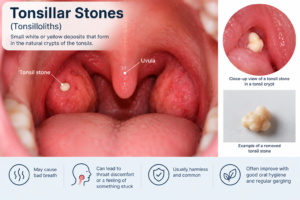
Tonsil stones, also called tonsilloliths, are small white or yellow deposits that form in the natural crypts of the tonsils. They are made of trapped food particles, mucus, bacteria and dead cells. Tonsil stones are usually harmless but may cause bad breath, throat discomfort, a feeling of something stuck in the throat, difficulty swallowing, or recurrent white spots on the tonsils.
Small tonsil stones often improve with good oral hygiene, regular gargling with warm salt water and adequate hydration. Persistent, large or frequently recurring tonsil stones should be assessed by an ENT specialist. In selected cases, removal of the stones or other treatment options may be considered.

Laryngitis and Hoarseness
Laryngitis is inflammation of the larynx (voice box) and commonly causes hoarseness or temporary loss of voice. It may occur following a viral infection, excessive voice use, irritation, smoking or acid reflux.
Symptoms may include hoarseness, voice changes, throat discomfort, dry cough and frequent throat clearing.
Most acute cases improve with voice rest, adequate hydration and avoidance of smoking and other throat irritants. Persistent hoarseness, particularly lasting more than a few weeks, should be assessed by an ENT specialist. Examination of the vocal cords may be performed using flexible laryngoscopy to identify the underlying cause.
Vocal Cord Nodules, Polyps and Granulomas

Vocal cord nodules, polyps and granulomas are benign lesions of the vocal cords that may cause persistent hoarseness, voice changes, vocal fatigue or a weak/breathy voice.
Vocal cord nodules usually develop from repeated or excessive voice use and commonly affect both vocal cords.
Vocal cord polyps usually affect one vocal cord and may develop following voice strain, irritation, smoking or other factors affecting the vocal cords.
Vocal cord granulomas commonly occur at the back of the vocal cords and may be associated with irritation, acid reflux or previous endotracheal intubation.
Diagnosis and Treatment
The vocal cords can be examined using flexible laryngoscopy. Treatment depends on the type and cause of the lesion and may include voice rest, voice therapy, treatment of contributing factors such as reflux, and avoidance of smoking and other irritants. Some persistent lesions may require surgical treatment.
Neck Lump

A neck lump or swelling can occur for many reasons. Common causes include enlarged lymph nodes due to infection, thyroid or salivary gland conditions, and congenital cysts. Less commonly, a persistent neck lump may be associated with a tumor and requires further assessment.
When Should a Neck Lump Be Checked?
An ENT assessment is recommended if a neck lump:
- Persists or continues to enlarge
- Is hard, fixed or painless
- Is associated with persistent hoarseness or voice changes
- Causes difficulty or pain when swallowing
- Is associated with persistent unexplained ear pain
- Is accompanied by an unexplained mouth or throat lesion
How Is a Neck Lump Investigated?
Assessment usually includes examination of the mouth, throat and neck and, when appropriate, flexible nasolaryngoscopy. Further investigations may include neck ultrasound, CT or MRI, depending on the suspected cause. In some cases, an ultrasound-guided fine-needle aspiration (FNA) or biopsy may be required.
Temporomandibular Joint (TMJ) Disorders
The temporomandibular joint (TMJ) connects the lower jaw to the skull and is located just in front of the ear. Problems affecting this joint and the surrounding muscles can cause jaw pain, facial pain, pain around the ear, clicking or popping of the jaw, difficulty opening the mouth, and pain while chewing.
TMJ symptoms may be associated with teeth grinding or clenching (bruxism), jaw muscle tension, dental problems, or abnormalities of the joint itself. Because TMJ pain can sometimes feel like an ear problem, an ENT examination may be helpful to exclude ear and other head and neck causes.
Treatment depends on the underlying cause and may include jaw rest, avoiding hard or chewy foods, warm compresses, appropriate pain relief, management of teeth grinding, and dental or maxillofacial assessment when required.
Salivary Gland Disorders

The major salivary glands include the parotid, submandibular and sublingual glands. They produce saliva, which keeps the mouth moist and helps with swallowing and digestion.
Common salivary gland problems include salivary stones, infections, recurrent swelling, cysts, and benign or malignant tumors.
Salivary Gland Stones

Salivary stones can block the flow of saliva and commonly cause pain and swelling during or around mealtimes. Repeated blockage may also lead to infection.
Salivary Gland Infection
An infected salivary gland may become painful, swollen and tender, sometimes with fever or discharge of pus into the mouth. Treatment depends on the underlying cause and severity.
Salivary Gland Swelling or Lump
Persistent or recurrent swelling of a salivary gland should be evaluated to determine the cause. Assessment may include clinical examination, ultrasound, CT or MRI, and when indicated, fine-needle aspiration (FNA) or biopsy.
Treatments and procedures in Throat and Neck Clinic
Flexible Laryngoscopy
Flexible laryngoscopy is a commonly performed ENT examination used to assess the nose, nasopharynx, throat, larynx and vocal cords.
A thin flexible endoscope with a small camera is gently passed through the nose, allowing direct examination of these areas. A local anesthetic or decongestant nasal spray may be used to make the examination more comfortable.
The procedure usually takes only a few minutes and can help evaluate symptoms such as persistent hoarseness, throat discomfort, difficulty swallowing, chronic cough, suspected vocal cord problems and other throat or voice disorders.
Tonsillectomy (Tonsil Removal Surgery)
Tonsillectomy is a surgical procedure to remove the tonsils. It may be considered for patients with recurrent tonsillitis, significantly enlarged tonsils causing breathing or swallowing problems, sleep-disordered breathing, recurrent peritonsillar abscess, or other selected tonsil conditions.
The procedure is performed under general anesthesia. Different surgical techniques may be used depending on the patient’s age, clinical condition and individual needs.
Before recommending surgery, an ENT specialist will assess the frequency and severity of infections, tonsil size, associated symptoms and the effect on the patient’s quality of life.
